

What is Play Therapy?
By Jordan Conley | October 28, 2025
I know it sounds made up. That’s what I thought too the first time I heard about play therapy, but it’s not! Play therapy is a therapeutic modality with evidence-based research for young children, adolescents, and even adults. There is so much power in a therapeutic modality that goes beyond the verbal content given by a client. Play therapy is among these approaches that goes deeper to a place within where a client is able to understand themselves, understand their challenges, and come to a place of healing.
“If you talk to a man in a language he understands, that goes to his head. If you talk to him in his language, that goes to his heart.” -Nelson Mandela
So, what even is play therapy? As defined by the Association for Play Therapy, Play Therapy is “the systematic use of a theoretical model to establish an interpersonal process wherein trained play therapists use the therapeutic powers of play to help clients prevent or resolve psychosocial difficulties and achieve optimal growth and development.” So, what does this mean? With my own clinical experience and background, I will mainly be sharing about play therapy working with children and adolescents.
Let’s start with a scenario I want you to picture to better understand what play therapy is all about and why it is effective. Imagine being spoken to in a language that was not your own, and be faced with the expectation of having to understand it to change or to better understand yourself. This could cause some confusion or frustration. Maybe you have experienced being in a place or different part of the world where you did not speak the language. How was this experience for you? If you haven’t experienced this, imagine what it would feel like being unable to express yourself to others? In my own experience, this heightens my anxiety, confusion, and frustration. How is it fair to expect someone to change, understand themselves, and to heal if they don’t have the language to do so? For children, using a traditional talk therapy is much like the above scenario. Feel free to watch this brief video to help illustrate the above scenario.
Introducing Andrew-https://www.youtube.com/watch?v=reJpo-GaopM
Children don’t always have the words or the understanding of the words in a way we adults might expect them to. Then when a big event happens (the traumatic event(s), the biggest tantrum, or the fight that causes disruption in the family), children may experience anxiety and/or confusion through the use of a talk therapy approach, halting the therapeutic process. Play therapy provides a child the words and language needed to process their own therapeutic experience. Play therapy opens the door for a child/adolescent to understand themselves in a way they verbally cannot. Through the utilization of pre-selected toys and materials in sessions, children and adolescents can process their feelings, enhance their social skills, and come to a place of healing and acceptance.
Play therapy is an evidence-based practice. It is beneficial to children as it utilizes the child’s primary language to help children navigate the presenting concerns that brought them to therapy. Play therapy has been shown through research to reduce a child’s stress in interpersonal relationships with peers and adults, decrease anxiety, enhance a child’s socio-emotional skills, increase self-esteem, and help children to manage behavioral issues (Koukourikos, 2021). The importance of play for children has been emphasized by some of the largest pioneers in the field of psychology, including Anna Freud, Virginia Axline, and Jean Piaget. There is evidence that this works, but you still may be asking how and why does it work?
The brain develops from bottom to top. The bottom structures of our brain (brainstem) are in charge of our more primitive, unconscious behaviors. Things like your breathing, heart beating, and your body’s ability to send messages about bodily functions (like when it’s time to eat or the need to use the restroom). The middle part (limbic system), or what can be called your “emotional brain” develops next. This part of your brain, as you might be able to guess, is largely made up of brain structures that help us to process emotions. This is also where structures involved with our memory reside too. If you think about your most distinct memories, it is likely tied to a strong emotional response like joy, fear or grief. This is by design, because this is the part that helps us to understand and process our life experiences. The last part of our brain to develop is what can be called the “thinking brain”, or our cortex. This part of our brain includes structures involved with our executive functioning and cognitive skills, like decision making, organization, emotional regulation, and problem solving. This part of our brain is said to not develop until about the age of 25. This means that children and adolescents are at times faced with trauma, anxiety, and other mental health concerns without access to the words or healthy coping techniques to process from a cognitive perspective what is going on. Play therapy can be what is referred to as a “bottom-up” approach, where the therapy really targets the lower, emotional and reactive parts of the brain rather than the cognitive parts, giving a child the language and resources they need to understand.
“Toys are children’s words and play is their language.”- Gary Landreth
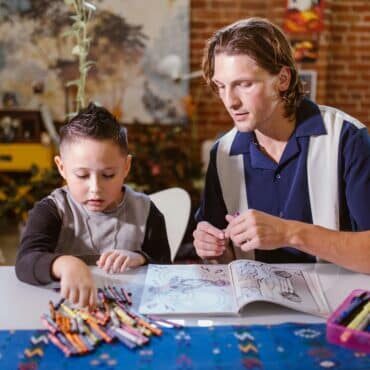
Children do more than “just play” with toys. Play is a child’s first language, a way for children to explore the world around them, and their way to understand and learn more about themselves. Play therapists and therapists who incorporate play, don’t just bring any toy into their office or play room. Toys and materials used in practice are introduced into the office with thoughtfulness and assessment of how this toy/material will be beneficial to a child’s needs. Similar to a therapist’s “tool box” of interventions and techniques that are used in a traditional talk therapy, the toys represent some of those same interventions and techniques. Materials included in play therapy can vary, from the use of art, miniatures, sand, dolls, action figures, masks, board games, puzzles, and so many other things you may have thought were “just toys”.
So if children just need the toys to communicate their thoughts and feelings, doesn’t that mean that anyone could provide play therapy? Not necessarily. Your child playing with toys does not replace the need for intervention from a licensed mental health professional if therapy is needed. Becoming a mental health therapist takes years of education and experience, with additional education and experience to become a Registered Play Therapist (RPT). To become a mental health professional one must meet the education requirements in their undergraduate degree, graduate degree, and meet all the licensing requirements for their discipline. Once a licensed mental health professional, one must engage in practice, training, and supervision by another experienced professional to incorporate play into their practice. Taking it a step further, a mental health professional could specialize in play therapy and become a Registered Play Therapist (RPT). To become an RPT, this takes a minimum of 2 years post education and licensing, over 350 hours of face-to-face interaction in play therapy with clients, 150 training hours, and 35 hours of supervision and observations by an approved Registered Play Therapist Supervisor (RPT-S). This is a lengthy process.
While it can be easy to dismiss play therapy as effective, it is an evidence-based practice that requires experience and continued education. On the surface a child’s play appears to be nonsensical, but it is a way for a trained professional to build a powerful relationship with a child, develop a level of understanding about a child’s psychosocial concerns, and when done appropriately and ethically, can encourage a child’s ability to grow, heal, and make sense of their ever-changing world. For more information about play therapy, you can visit the Association for Play Therapy’s website, https://www.a4pt.org/page/AboutAPT
Sources:
https://traumaresearchfoundation.org/how-does-play-therapy-work-a-bottom-up-approach/
https://pmc.ncbi.nlm.nih.gov/articles/PMC8812369/
https://www.psychologytoday.com/us/blog/simplifying-complex-trauma/202112/how-bottom-treatment-can-address-trauma
https://www.a4pt.org/page/AboutAPT

About The Author
Jordan Conley
Jordan's approach to therapy is person-centered, meaning she truly lets you or your child guide the therapeutic process. She strives to build an authentic and positive therapeutic relationship in her practice. For Jordan, it is to create a safe, supportive, and nonjudgmental space that encourages healing and growth. Beginning the process of bringing yourself, family, or child to therapy is not always easy. So, it is important to her that you feel comfortable and your true self when you enter my therapeutic space.
Jordan's background consists primarily of working with children in schools utilizing play therapy techniques, so often she enjoys the use of hands-on interventions, be it through art, play, and other creative interventions when appropriate.